
Starlink's First Space Debris Event

After more than the equivalent of 20,000 years of operational time, the first Starlink debris-producing event occurred on December 17, 2025. The rapid response of commercial space surveillance companies and the subsequent public disclosure of details was impressive, providing immediate insight into the magnitude and consequence of the event—which was fortunately minimal. Unfortunately, both the US Government and Starlink failed to provide a risk assessment for the Chinese Space Station, contrasted by the explicit mention of no risk assessed to the International Space Station.
Notification by Starlink
As is increasingly common, the first public notification of the event did not come from the the U.S. Department of War via USSPACECOM, but rather via a social media post by Starlink (X post, below) with the root cause attributed to the propulsion system.

Fortunately, the Starlink-35956 satellite (66629 / 2025-271N), recently launched on November 3, 2025, was still ascending to its operational altitude. As such, the event occurred at the relatively low altitude of 418 km, or sufficiently low for drag to ensure a relatively short-lived debris lifetime.
Crewed Flight Risk Assessment
Starlink’s notification also identified that the failed satellite posed no risk to the International Space Station (ISS), but unfortunately left out any mention of the other crewed space station, the Chinese Space Station, which was 27 km below the ISS and presumably at more risk than the ISS. Similarly, the only US Government statement on the event also highlighted there was no assessed risk to the ISS, but failed to mention the Chinse Space Station (ref graphic).

The lack of mentioning or acknowledging PRC human spaceflight interests will only fuel the growing rhetoric and concern expressed by Chinese officials over the “reckless expansion” of Starlink satellites (ref X post).
No, it is not the Department of War’s mission to provide spaceflight safety and collision notifications to the world, but it is the only entity which has been fulfilling that role. I assert the absence of acknowledging the Chinese Space Station is step backward in establishing the US as a leader in “norms of behavior” for the space domain. Establishing this leadership is ultimately in the long-term national security interest of the United States. Perhaps once the Office of Space Commerce’s Traffic Coordination System for Space (TraCSS) gets established a more deliberate and intentional communication strategy can be realized?
Commercial SSA Steps In
Within five hours of Starlink’s event notification, LeoLabs, a commercial space surveillance radar company, stated it had detected “tens of objects” associated with the event (ref X post, below). This was followed up by a post by Ed Lu of LeoLabs stating that “hundreds” of objects were being tracked and the spread of objects had exceeded 6000 km (or around one quarter of a LEO orbit).

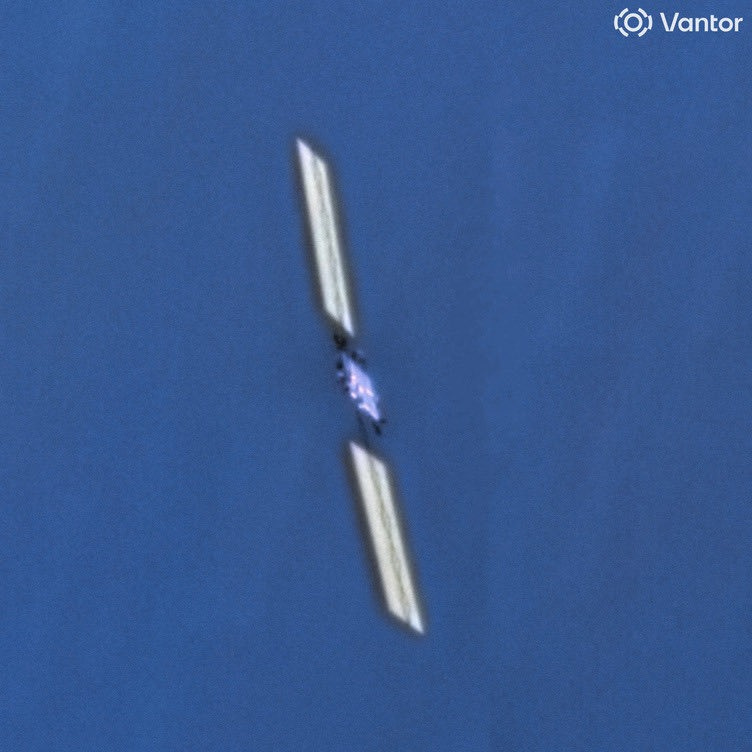
This was followed by a social media post by Starlink’s VP of Engineering, Michael Nicolls, of a resolved image of the ill-fated Starlink satellite taken by Vantor’s WorldView-3 satellite. The image illustrated all the structural elements of the satellite remaining intact without extensive physical damage (see image below, source from X post). It’s remarkable to see these these “Non Earth Images” come to life, providing a focused exemplar on what deregulation of NEI capabilities has enabled for US commercial companies. (Curiously, it is stated the image was taken over Alaska, though my independent analysis finds it more likely to have occurred closer to the south pole on December 18, 2025, at 23:05 UTC).
Current Status
As of January 2, 2026, Starlink 35956 was at at 365 km altitude having decayed more than 50 km. It is now well below the altitudes of both crewed space objects—the International Space Station and Chinese Space Station (see figure below).
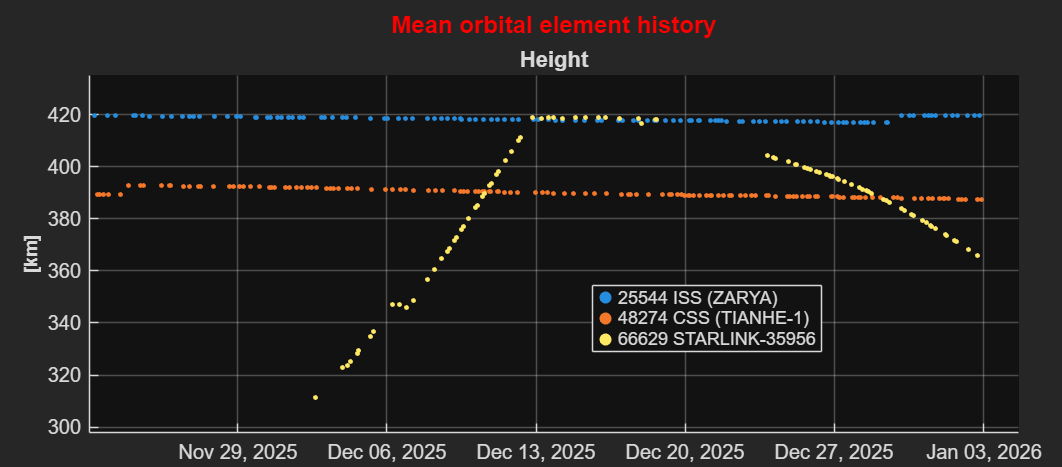
There have been no debris objects cataloged from the event, and it is unlikely we will see any cataloged given the sparsity of new debris objects being cataloged US Space Forces-Space. Given the altitude of the parent object, and the higher drag on the debris objects it is probable the vast majority (if not all) of the debris are well below all crewed altitudes and will soon have their remaining orbital energy dissipated from drag.
Chronology of social media posts
2025-12-18 16:31 Initial event notification via Starlink X Post →
2025-12-18 21:04 LeoLabs X Post →
2025-12-20 00:16 Ed Lu (LeoLabs) X Post →


2025-12-20 16:42 Michael Nicolls X Post →


I was remiss in not providing this EO collection of the debris by Sybilla Technologies of Poland via their Panoptes telescope network. LinkedIn post with video of debris collected 2025-12-19 13:35 UTC --> https://www.linkedin.com/posts/sybilla-technologies_fragmentation-event-detected-starlink-activity-7408231584664936448-t2pV